Why Prayer Times Differ Between Apps in Riyadh
Open two prayer apps on the same phone in Riyadh and there is a fair chance they won’t agree. Fajr might be a few minutes apart, Isha can be off by twenty minutes or more, and Asr sometimes shows a gap of over an hour. None of the apps is broken. They are simply answering the same question with different rules.
Here is what is going on, and which time to follow if you live in Riyadh.
1. Different calculation methods
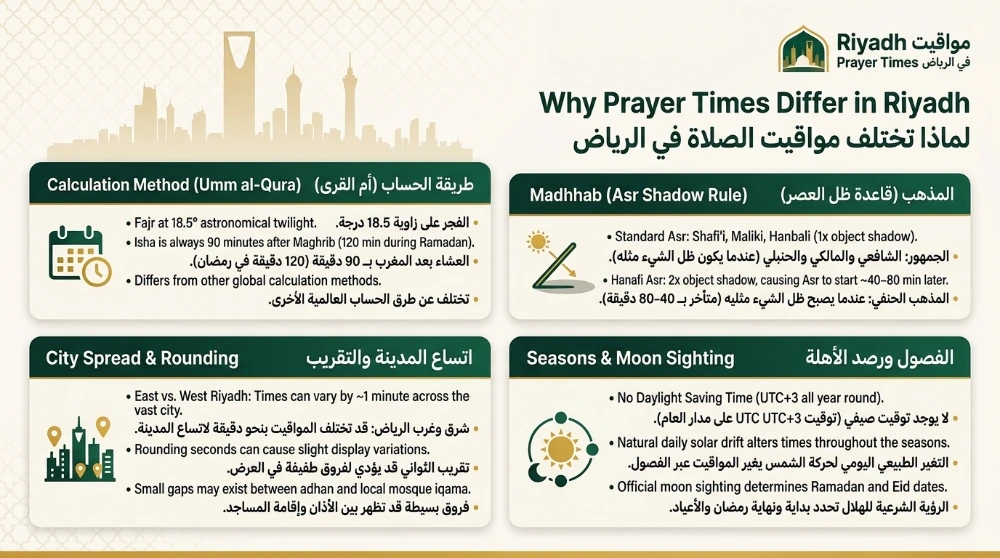
Dhuhr, Asr and Maghrib come from the sun’s position and are fairly fixed. Fajr and Isha are different: they depend on twilight, and scholars and institutions have defined twilight in slightly different ways. Each definition became a “method”, and every app picks one, often based on your country or whatever its developer chose as a default.
To show how much this matters, here are Fajr and Isha for Riyadh on 20 November 2026 under five common methods:
| Method | Fajr | Isha |
|---|---|---|
| Umm al-Qura (Saudi official) | 4:51 AM | 6:35 PM |
| Muslim World League | 4:53 AM | 6:20 PM |
| Egyptian General Authority | 4:47 AM | 6:22 PM |
| Karachi (University of Islamic Sciences) | 4:53 AM | 6:24 PM |
| ISNA (North America) | 5:07 AM | 6:11 PM |
Same city, same day: Fajr spreads across about 20 minutes and Isha across about 24.
2. The 90-minute Isha rule
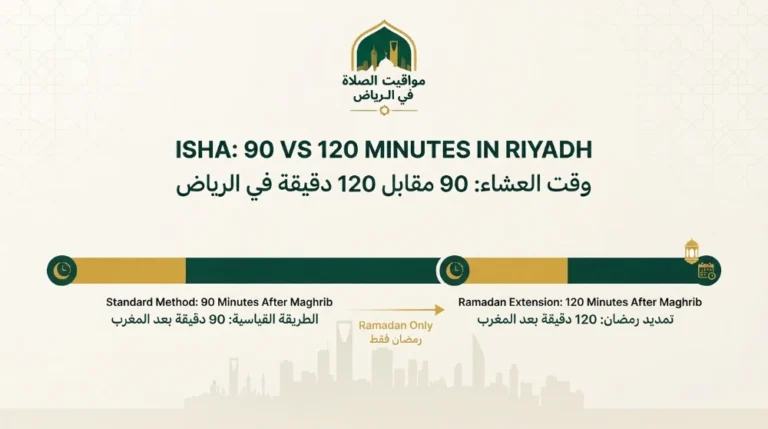
The biggest Isha difference comes from how Umm al-Qura works. Instead of measuring twilight, it sets Isha at a fixed 90 minutes after Maghrib, and 120 minutes during Ramadan. Most other methods calculate Isha from the sun’s angle below the horizon, which in Riyadh usually lands earlier. That’s why an app set to Muslim World League may show Isha 15 minutes before the mosque down your street calls the adhan. Read more on the Isha time in Riyadh page.
3. Asr: Standard or Hanafi
Asr has two accepted starting points. The majority of schools begin it when an object’s shadow equals its length (plus the noon shadow); the Hanafi school waits until the shadow is twice the length. In Riyadh that gap is roughly 40 to 80 minutes depending on the season. If one app says 3:05 PM and another says 3:55 PM, check the fiqh setting. We explain it fully in Hanafi vs Standard Asr.
4. Location and manual adjustments
Riyadh is a large city. The sun sets about two minutes later in the west of the city than in the east, so an app using your GPS can differ slightly from one using the city centre. Some apps and mosques also add a minute or two of caution (ihtiyat) to Fajr or Maghrib, and a few let users add their own offsets and then forget they did.
Which time should you follow in Riyadh?
Mosques across Saudi Arabia follow the Umm al-Qura calendar, so if you pray in congregation or want your times to match the adhan you hear, set your app to Umm al-Qura. That is the default on this site’s Riyadh prayer timetable. For Asr, choose Standard or Hanafi according to the school you follow. If you are unsure about a ruling for yourself, ask a scholar you trust; this article explains the timings, it isn’t a fatwa.
Frequently asked questions
Why is Isha so late in Saudi Arabia?
Because the Umm al-Qura method places Isha 90 minutes after Maghrib (120 in Ramadan) rather than calculating it from twilight, which usually gives an earlier time.
Which calculation method do Riyadh mosques use?
Mosques in Riyadh follow the Umm al-Qura calendar issued in Saudi Arabia. Our method is explained on the calculation method page.
Why does my app show a different Fajr time from the mosque?
Usually the app is set to a different method, such as Muslim World League or ISNA, or it has a manual adjustment. Switch it to Umm al-Qura and remove any offsets. See today’s Fajr time in Riyadh.
Is a two-minute difference a problem?
Small differences of one or two minutes usually come from location and rounding. Many people wait a few minutes after the listed time for Fajr and before the end of a prayer window, just to be safe.